.png)

Joe Carter
August 28, 2026
From Lab to Market: Why Great Energy Technology Is Not Enough
Innovation creates possibility. Commercialization creates value.
The energy sector is full of remarkable technology.
Solar. Hydrogen. Battery storage. Nuclear fusion. AI-driven infrastructure.
But having breakthrough technology does not automatically create a valuable business.
The real challenge begins when an organization has to take an idea out of the lab and turn it into something customers will buy, partners will support, teams can deliver, and investors can scale.
That was a central theme in my recent conversation with Dr. Michael Ginsberg, president of Tokamak Energy.
Michael has spent nearly two decades working across the energy sector, from solar and hydrogen to nuclear fusion. Our conversation reinforced a principle that applies far beyond energy:
Technical innovation and commercial success are two different capabilities.
A company needs both.
The Commercialization Gap
Some of the world's smartest people are working inside universities, national laboratories, research organizations, and deep-tech companies.
They can solve incredibly difficult technical problems.
But there is a gap between proving that something can work and proving that it works as a business.
That gap is where commercialization happens.
A promising technology eventually has to answer practical questions:
- Who is the customer?
- What problem are we solving for them?
- Why is our solution better than what they use today?
- What will they pay for it?
- Can we deliver it consistently?
- Can we scale without destroying margins?
- Can the organization operate without depending on a handful of technical experts?
- Can we measure performance clearly enough to attract capital and strategic partners?
These aren't secondary questions.
They determine whether innovation becomes an asset or remains an experiment.
Technology Has to Become a Value Proposition
One of the biggest shifts occurs when a technically driven organization begins to scale.
Early on, the focus is naturally on the technology.
Does it work?
Can we make it better?
Can we solve the next engineering problem?
Those questions matter. But as commercialization approaches, leadership has to ask a different question:
Why should the customer care?
Customers rarely buy technology because the science behind it is impressive.
They buy outcomes.
That could mean lower cost, better reliability, increased capacity, faster deployment, reduced risk, greater energy security, improved sustainability, or some combination of those benefits.
This is where technically brilliant companies can struggle.
The organization has spent years learning how to build the technology. Now it has to learn how to build the business around the technology.
That requires a cultural shift.
Scaling Requires a Different Operating System
Commercialization also changes what the company needs from its systems and leadership.
A small technical team can operate through direct communication, institutional knowledge, and individual expertise.
A scalable company cannot.
As the organization grows, knowledge has to move out of people's heads and into documented systems.
Responsibilities need clear owners.
Processes need to be repeatable.
Performance needs measurable KPIs.
Decisions need reliable data.
Leadership needs accountability.
This is where commercialization and enterprise value begin to intersect.
At Twin Flame Group, we look at value creation through many of these same operational lenses: KPI professionalization, workflow clarity, leadership capability, pricing, operational optimization, scalability, and exit readiness.
The principle is simple:
If the business cannot repeat the result without depending on a few key people, it has not truly scaled.
That matters whether you are running a service business, a multi-unit operation, a manufacturing company, or developing the next generation of energy technology.
AI Is Making the Energy Question Bigger
The rise of artificial intelligence makes this conversation even more important.
AI requires enormous computing capacity.
Computing capacity requires data centers.
And data centers require power.
The issue is no longer simply whether we can generate enough energy.
We also have to think about where that energy comes from, how reliably it can be delivered, what infrastructure is required, what it costs, and how surrounding communities are affected.
That creates both a challenge and an opportunity for energy innovators.
Demand may be significant.
But demand alone does not guarantee commercial success.
Energy companies still have to build a model capable of converting that demand into sustainable economic value.
Innovation Must Create a Commercial Advantage
Every emerging technology eventually faces competition from an existing alternative.
That alternative does not need to be technically superior.
It may already have infrastructure.
It may already have customers.
It may already have regulatory acceptance.
It may already have an established supply chain.
It may simply be cheaper or easier to buy.
That means a new technology needs a clear reason to win.
A leadership team should be able to explain:
What does this technology allow the customer to do better than the alternatives?
If the answer is unclear, commercialization becomes difficult regardless of how impressive the technology may be.
A strong value proposition then needs to become part of the company's operating model.
Sales teams need to understand it.
Partners need to understand it.
Investors need to understand it.
Government stakeholders may need to understand it.
Most importantly, customers need to experience it.
Strategic Partnerships Become Part of the Business Model
Deep-tech commercialization rarely happens in isolation.
Energy companies may need relationships across government, utilities, manufacturers, infrastructure providers, capital partners, research organizations, suppliers, and major customers.
Those relationships aren't simply networking opportunities.
They can become part of the company's ability to scale.
This changes what leadership must be capable of doing.
The person who can lead an organization through a technical breakthrough may not have every capability required to lead it through commercialization.
Commercialization can require experience with:
- Strategic partnerships
- Government relations
- Capital formation
- Customer development
- Pricing
- Regulatory environments
- Supply chains
- Operational scaling
- Talent development
- Performance management
The company has to recognize those gaps before they become bottlenecks.
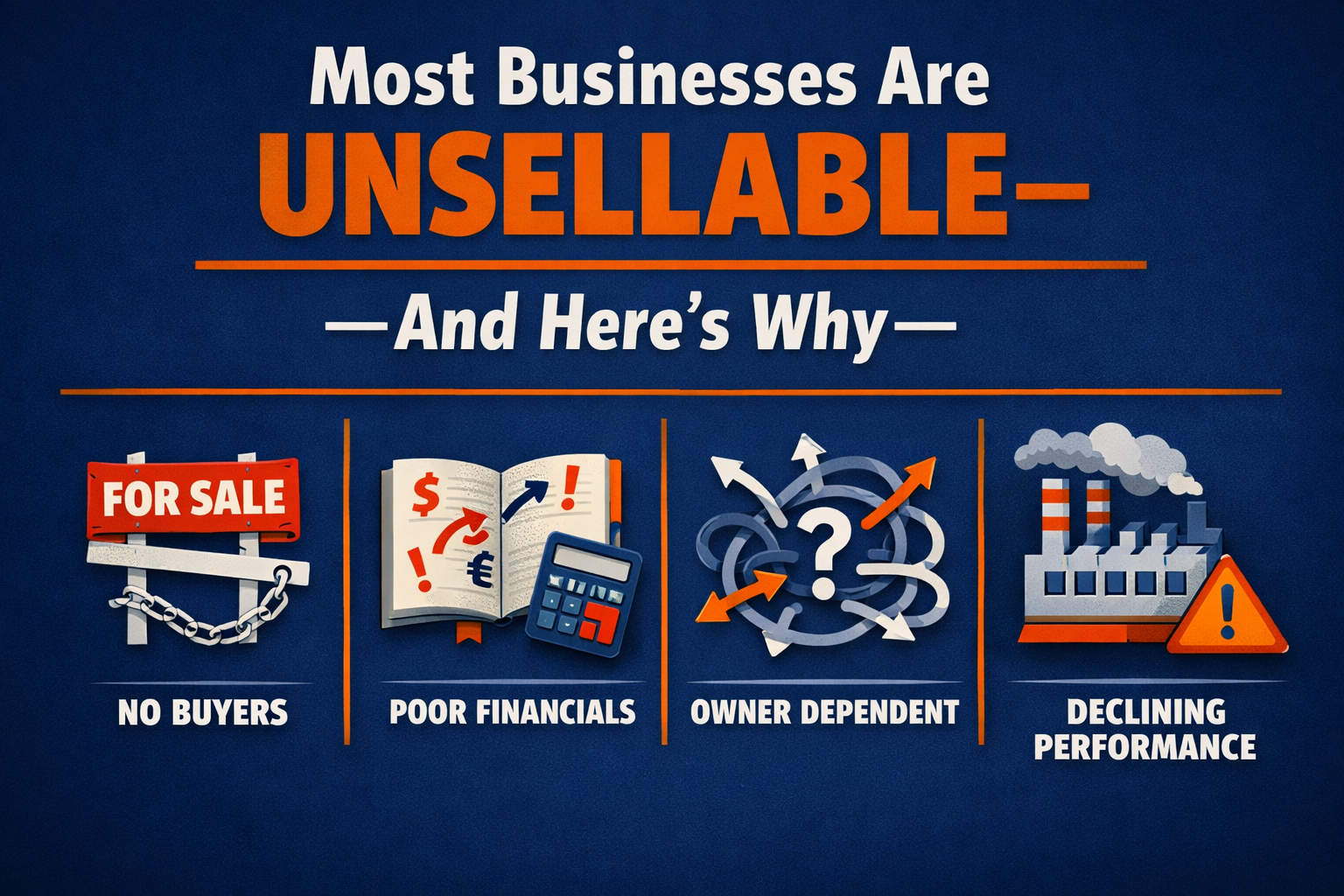
Founder and Expert Dependency Is a Business Risk
This is particularly important for companies built around highly specialized expertise.
If every major decision requires the founder, chief scientist, lead engineer, or another key individual, the organization has a dependency problem.
That dependency limits scale.
It also creates risk.
The answer isn't to remove technical expertise from the business. The answer is to build systems around that expertise so the organization can multiply it.
Document the process.
Define decision rights.
Build the KPI dashboard.
Create accountability.
Develop the next layer of leadership.
Turn individual knowledge into organizational capability.
That is how a company becomes transferable.
And transferability matters because buyers and investors are not simply buying what a company produces today.
They are buying confidence in what the organization can produce tomorrow.
Commercialization Is a Value-Creation Process
This is why I look at commercialization as more than a sales challenge.
It is a value-creation process.
A business becomes more valuable as uncertainty is replaced with evidence.
Can customers be acquired consistently?
Can pricing support healthy margins?
Can delivery be standardized?
Can leadership operate without constant founder intervention?
Can KPIs identify problems before they become expensive?
Can processes be replicated across markets?
Can the business convert growth into EBITDA?
Those capabilities build confidence.
And confidence affects value.
Revenue is a byproduct.
Value is the objective.
Systems create value.
Documentation protects value.
Accountability sustains value.
The Leadership Team Has to Evolve With the Company
Michael used the image of a butterfly emerging from a cocoon to describe the transition from deep technology to commercialization.
It is an appropriate comparison.
The organization that develops the technology is not necessarily the same organization required to commercialize it at scale.
Roles change.
Processes change.
Leadership requirements change.
Capital requirements change.
Customer expectations change.
The company has to evolve with them.
This is where leadership discipline becomes critical.
The same four questions I want serious operators asking inside established companies apply here:
- Clear Goals — What commercial outcome are we trying to achieve?
- Measurable Milestones — How will we know whether commercialization is working?
- Specific Actions — What has to happen next, and who owns it?
- Weekly Accountability — Are we reviewing execution consistently?
Those are the 4 Modus Operandi.
Strategy without execution does not create enterprise value.
The Bigger Lesson for Business Owners
You do not have to be developing nuclear fusion to learn from this conversation.
Every growing business eventually faces its own version of the lab-to-market problem.
You figured out how to deliver something customers wanted.
Now you have to turn that capability into a business that can scale.
That means moving from:
Knowledge to documentation.
People to systems.
Activity to KPIs.
Founder decisions to leadership accountability.
Revenue growth to enterprise value creation.
The companies that make that transition become easier to scale, easier to operate, easier to diligence, and ultimately more transferable.
The companies that don't often discover that growth has simply created a larger organization that remains dependent on the same handful of people.
That isn't scale.
It is complexity.
Build the Business Around the Innovation
The future of energy will require significant technological breakthroughs.
But breakthroughs alone will not be enough.
We also need companies capable of commercializing them.
That means building organizations with clear value propositions, strong leadership, documented systems, measurable performance, strategic partnerships, and the operational discipline required to scale.
The technology may open the door.
The business model determines whether you can walk through it.
For business owners and leadership teams, the question is the same:
Are you simply building something that works—or are you building an asset that can scale without you?
If you want to identify the systems, KPI, accountability, and founder-dependency gaps limiting the value of your business, book a valuation call with Twin Flame Group.
Visit www.twinflametx.com.
Joe Carter
Learn more about our founder Joe Carter, a nationally recognized business consultant and speaker.
Follow us on Linkedin