
Joe Carter
April 1, 2026
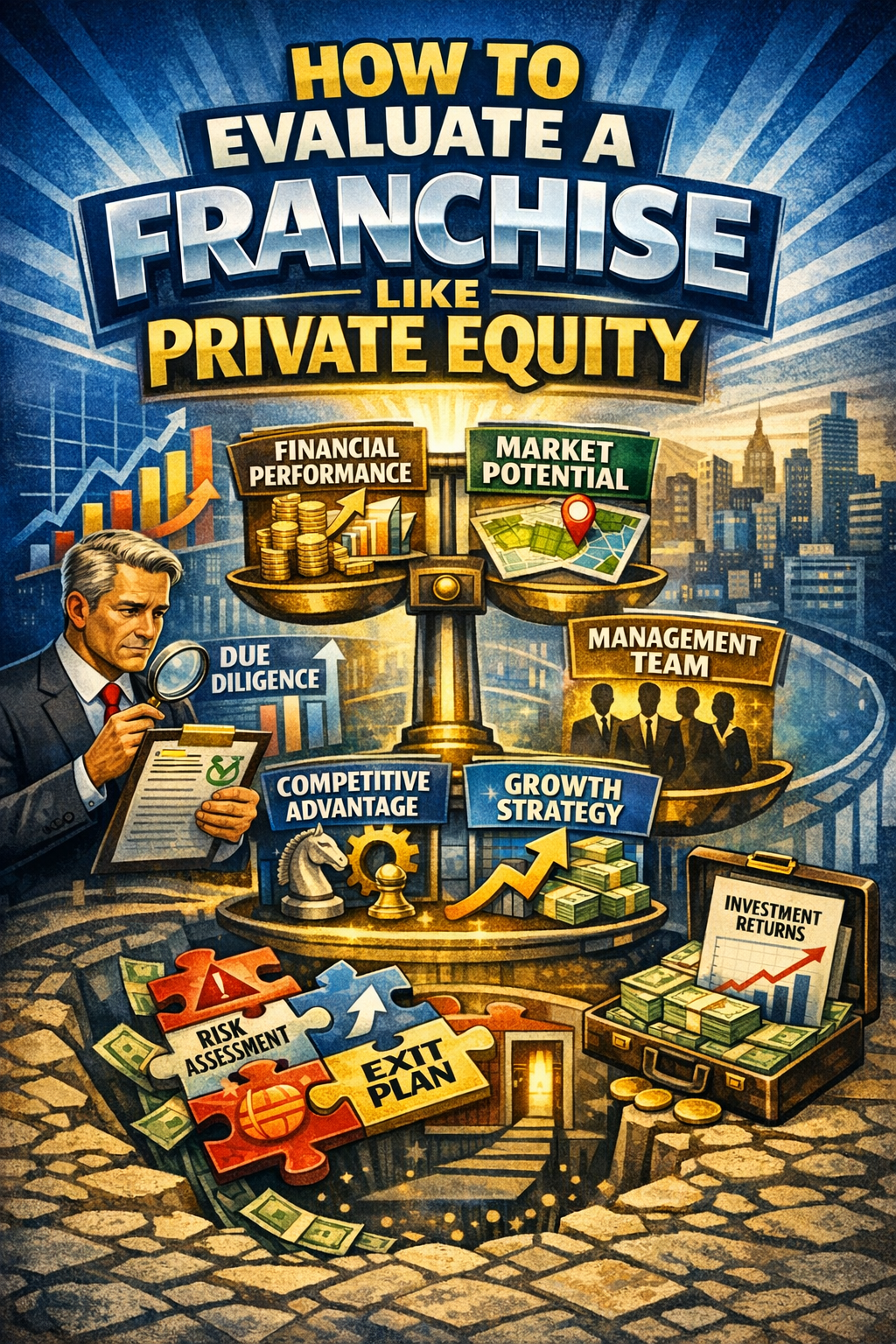
How to Evaluate a Franchise Like Private Equity
Private equity doesn’t evaluate a franchise the way most buyers do.
They don’t start with the brand.
They don’t start with marketing.
And they don’t start with projected growth.
They start with structure.
Because structure determines whether any of those things actually hold.
The First Question Most Buyers Skip
The first question is simple:
What does this business produce—consistently?
Not during peak months.
Not under the current owner.
Not based on projections.
Consistently.
That distinction matters more than most buyers realize.
Jim Collins, in Good to Great, emphasized the importance of disciplined systems over charismatic leadership. The same idea applies here. If performance depends on conditions being right—or the right person being involved—it’s not reliable.
And if it’s not reliable, it’s not valuable at a premium.
From Performance to Repeatability
Most buyers are drawn to performance.
Private equity is focused on repeatability.
There’s a difference.
Performance can be influenced by:
- timing
- effort
- short-term decisions
Repeatability comes from:
- systems
- process
- control
This is why professional buyers move quickly past surface-level metrics and into the underlying mechanics of the business.
They’re not asking:
“How well is this doing?”
They’re asking:
“Why is it doing that—and will it continue?”
Where the Real Evaluation Happens
Once consistency is understood, the next layer is operational discipline.
This is where the business either holds—or starts to show stress.
Private equity firms look closely at:
- Margin stability
Are margins consistent across time, or do they fluctuate based on management involvement? - Cost control
Is spending structured and predictable, or reactive? - Labor efficiency
Is labor aligned to output, or does it expand without control? - Unit-level economics
Does each location perform independently, or are stronger units masking weaker ones?
These aren’t abstract concepts.
They are measurable.
And they directly impact valuation.
As Howard Marks has pointed out in his memos, understanding risk requires going beyond the obvious and looking at what’s beneath the surface. That’s exactly what this level of analysis is designed to do.
Testing Scalability—Not Assuming It
Once the core operation is understood, the next step is scalability.
This is where many franchise buyers make a critical mistake.
They assume that because a business works in one location, it will work in five.
Private equity doesn’t assume.
They test.
They ask:
- Can this model be replicated without adding complexity?
- Do systems hold as volume increases?
- Does performance stay consistent across locations?
Reed Hastings, co-founder of Netflix, has spoken about scaling culture and systems intentionally, not organically. Businesses that scale without structure don’t actually grow—they expand their problems.
Franchise systems are no different.
If execution breaks at scale, the model isn’t scalable.
The Final Test: Dependency
The last piece—and often the most important—is dependency.
What happens when ownership changes?
If:
- decisions slow down
- performance drops
- or issues increase
Then the business was never stable to begin with.
Ray Dalio’s principle of building systems that function independently of individuals applies directly here. Businesses that rely heavily on a single operator carry inherent risk.
And risk gets priced into every deal.
Where Most Buyers Go Wrong
Most individual buyers skip this entire process.
They rely on:
- broker summaries
- adjusted financials
- surface-level KPIs
They focus on what’s presented, not what’s validated.
That’s not due diligence.
That’s acceptance.
And it’s where mistakes are made.
Because what’s presented is optimized to sell the business.
What’s validated determines what the business is actually worth.
Evaluation Is Not About Finding Upside
This is where the mindset shift needs to happen.
Most buyers approach deals looking for upside.
Private equity approaches deals looking for what holds.
Upside is uncertain.
Structure is not.
Charlie Munger often talked about avoiding stupidity instead of chasing brilliance. In acquisitions, that means identifying what could go wrong before getting excited about what could go right.
Because once you own the business, the downside becomes your responsibility.
Final Thought
Evaluating a franchise isn’t about identifying potential.
It’s about confirming stability.
The question isn’t whether the business can grow.
It’s whether it can continue to perform under new ownership, with different decisions, under different conditions.
Private equity understands that.
Most buyers don’t.
And that difference is where value is either protected—or lost.
Joe Carter
Learn more about our founder Joe Carter, a nationally recognized business consultant and speaker.
Follow us on Linkedin.png)