

Joe Carter
April 3, 2026
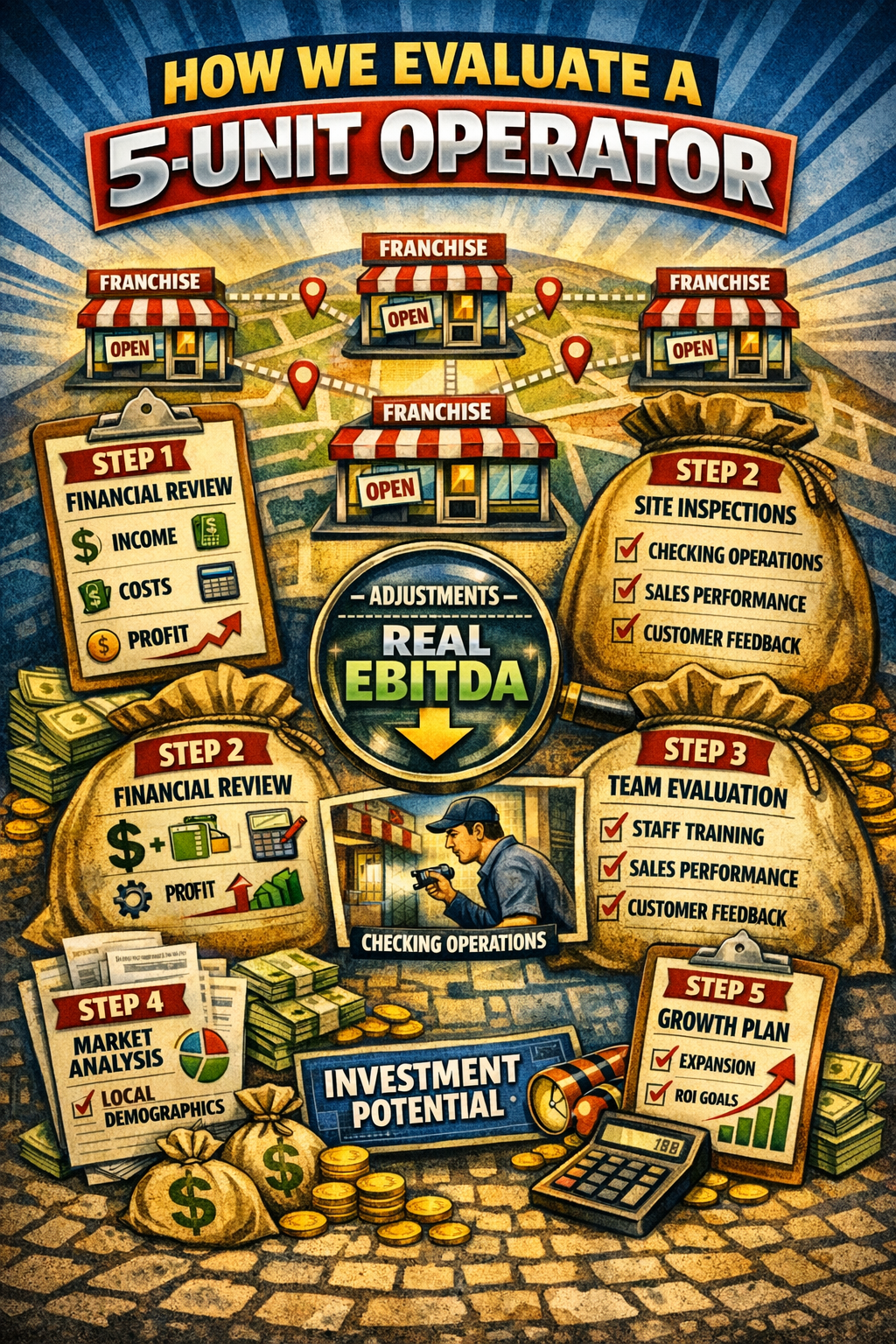
How We Evaluate a 5-Unit Operator
At five units, most operators believe they’ve figured it out.
From the outside, it looks like they have.
Multiple locations.
Growing revenue.
A team in place.
It signals scale.
But this is usually the point where the business starts to show stress.
Not because it’s failing.
Because it hasn’t been built to handle what comes next.
Why Five Units Is a Critical Threshold
The transition from one or two locations to five is not linear.
It changes how the business operates.
At one location, the owner is close to everything:
- decisions are immediate
- problems are solved quickly
- performance is directly managed
At five, that breaks.
Decisions get distributed.
Execution gets inconsistent.
Visibility starts to fade.
What used to be controlled becomes coordinated.
And coordination introduces risk.
Andy Grove, former CEO of Intel, emphasized that complexity increases faster than control as organizations grow. That principle shows up clearly at this stage.
What looks like scale is often just expanded exposure.
First: Consistency Across Locations
The first thing we look at is consistency.
Not overall performance.
Distribution of performance.
Are margins aligned across locations?
Or is one unit carrying the rest?
In most cases, you’ll find variation.
One strong location.
Two average.
One underperforming.
From a distance, the numbers average out.
From a buyer’s perspective, that’s a problem.
Because inconsistency introduces questions:
- Why does one unit outperform?
- Is that repeatable?
- What happens if that unit declines?
Howard Marks has written that risk often hides in averages. That’s exactly what happens here.
Buyers don’t underwrite averages.
They underwrite stability.
Second: Operator Involvement
The next thing we evaluate is the owner’s role.
At five units, the operator should not be involved in daily problem-solving.
If they are, the business hasn’t scaled.
It’s just become more complex.
This shows up in subtle ways:
- The owner is still handling staffing issues
- Still resolving customer problems
- Still making operational decisions across locations
From the outside, that can look like strong leadership.
In a transaction, it’s dependency.
Ray Dalio has consistently emphasized that systems should replace reliance on individuals. If performance depends on one person, the business is fragile.
And fragile businesses don’t transfer cleanly.
Third: Visibility Into Performance
The third area is visibility.
This is where most operators fall short.
We look for clear, consistent KPIs across:
- Labor efficiency
- Revenue per job or customer
- Customer retention
- Unit-level profitability
Not reports that exist.
Reports that are used.
Because there’s a difference.
Many operators have data.
Few operate from it.
Decisions are still made based on:
- instinct
- experience
- urgency
That works at one location.
It breaks at five.
Peter Drucker’s principle—“what gets measured gets managed”—is often quoted, but rarely applied with discipline. Without real visibility, performance becomes reactive instead of controlled.
And reactive businesses are unpredictable.
What We Usually Find
In most five-unit operations, performance varies more than expected.
Margins aren’t consistent.
Labor isn’t optimized.
KPIs aren’t driving decisions.
And the owner is still more involved than they should be.
None of this means the business is weak.
It means it’s unfinished.
Why This Matters in a Deal
From a buyer’s perspective, variation is risk.
And risk affects:
- valuation
- deal structure
- financing
If performance isn’t consistent, buyers assume it can decline.
If the owner is required, buyers assume additional cost.
If KPIs aren’t clear, buyers assume inefficiency.
All of that gets priced in.
Charlie Munger often talked about avoiding uncertainty rather than chasing upside. In acquisitions, that translates to discounting anything that isn’t clear.
The Difference Between Growth and Structure
Most operators at this stage have proven they can grow.
What they haven’t proven is that the business can operate without them.
That’s the next level.
It requires:
- systemizing decisions
- standardizing execution
- creating visibility across all units
Without that, adding more locations doesn’t increase value.
It increases exposure.
Final Thought
At five units, the question is no longer:
“Can this business grow?”
It’s:
“Can this business operate consistently without the owner?”
Most can’t.
Not yet.
And that’s where value is either built—or limited.
Because buyers aren’t paying for how far you’ve come.
They’re paying for how stable the business is when you’re no longer in it.
Joe Carter
Learn more about our founder Joe Carter, a nationally recognized business consultant and speaker.
Follow us on Linkedin.png)