
Joe Carter
April 5, 2026
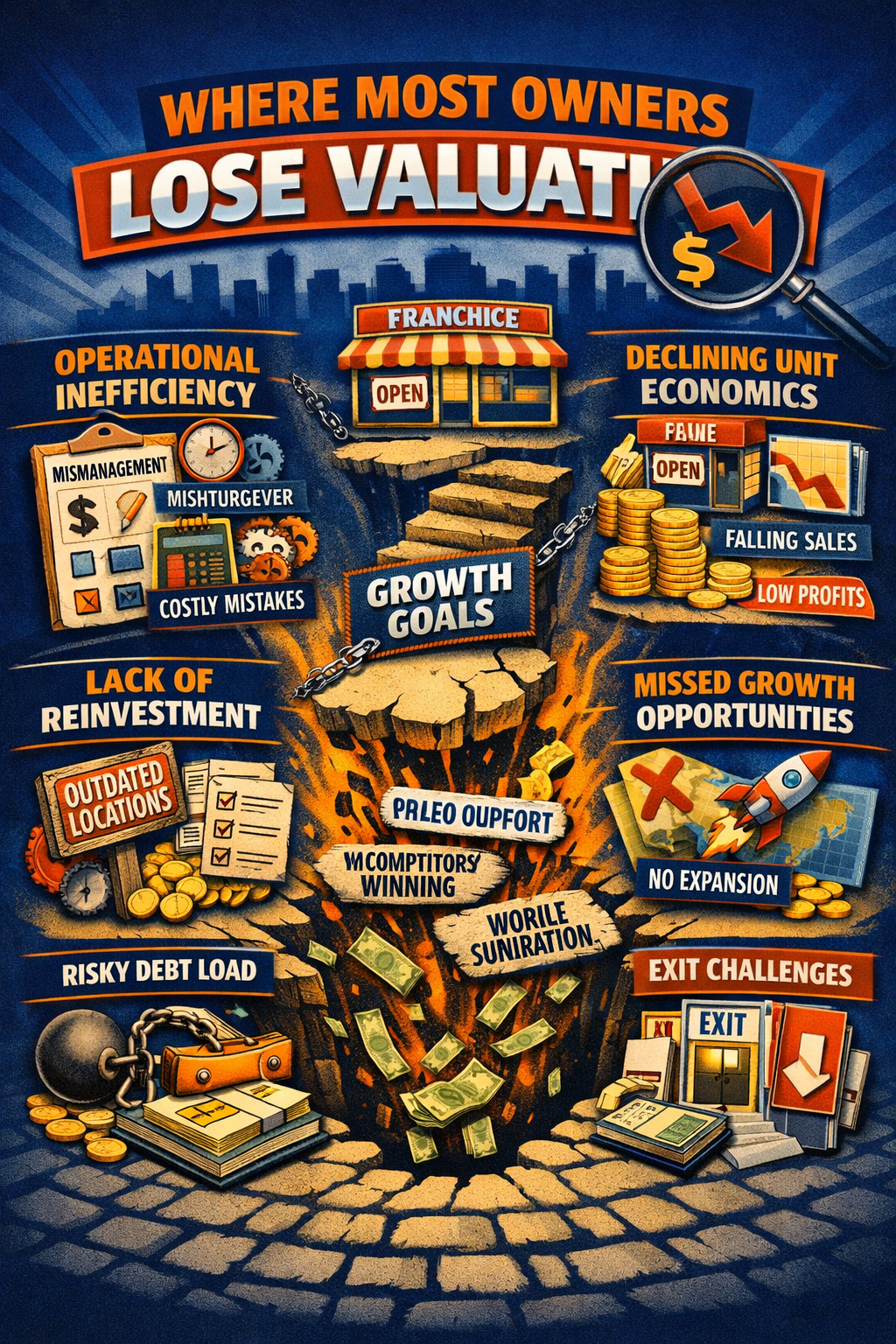
Where Most Owners Lose Valuation
Valuation doesn’t drop all at once.
It erodes.
Slowly.
And usually in places owners don’t track.
That’s what makes it dangerous.
Because by the time it shows up in a deal, it’s already too late to fix.
The Misconception About Valuation
Most owners think valuation is determined by:
- revenue
- growth rate
- market demand
Those matter.
But they don’t determine the final number.
Buyers don’t price performance alone.
They price risk.
And risk shows up in the gaps—specifically, in what cannot be clearly proven.
Warren Buffett has long emphasized that uncertainty—not volatility—is the real risk in investing. In acquisitions, uncertainty shows up when a business cannot clearly explain or validate its performance.
That’s where valuation starts to decline.
Why Valuation Erodes Instead of Drops
In most deals, value isn’t lost in a single moment.
It’s chipped away during diligence.
Each unanswered question.
Each inconsistency.
Each area that requires explanation instead of evidence.
Individually, they seem manageable.
Collectively, they change how the business is perceived.
And perception drives price.
Howard Marks has written extensively about how risk is often misunderstood because it’s not immediately visible. In transactions, risk becomes visible through diligence.
And once it’s visible, it gets priced in.
The Four Areas Where Value Is Lost
Across deals, the same issues show up repeatedly.
Not because businesses are weak.
Because they are unclear.
1. Unclear Financials
Financials don’t need to be perfect.
They need to be understandable.
When buyers see:
- inconsistent reporting
- unexplained adjustments
- unclear cost allocation
They don’t assume it’s harmless.
They assume risk.
Because if financial performance can’t be clearly validated, it can’t be trusted.
And if it can’t be trusted, it gets discounted.
2. Inconsistent Margins
Revenue can grow while margins quietly decline.
Many owners don’t track this closely across time or locations.
Buyers do.
They look for:
- stability
- predictability
- control
If margins fluctuate without clear explanation, buyers assume:
- operational inconsistency
- cost issues
- lack of discipline
All of which reduce confidence.
And lower confidence reduces valuation.
3. Undocumented Operations
In many businesses, processes exist—but only in people’s heads.
That works internally.
It doesn’t transfer.
When operations are undocumented:
- execution becomes dependent on individuals
- training becomes inconsistent
- performance becomes variable
Ray Dalio has consistently emphasized the importance of systemizing how work gets done. Without systems, outcomes depend on people.
And people introduce variability.
Buyers don’t pay for variability.
4. Owner Dependency
This is the most common—and most expensive—issue.
If:
- decisions run through the owner
- relationships depend on the owner
- problems are solved by the owner
Then the business is not independent.
It’s supported.
From a buyer’s perspective, that creates immediate questions:
- What happens when the owner leaves?
- Who replaces that role?
- What does that cost?
Those questions don’t get answered with optimism.
They get answered with discounts.
How Buyers Actually React to These Gaps
Most owners assume buyers will “work through” these issues.
They don’t.
They adjust for them.
That shows up in three ways:
- Lower price
Because future performance is less certain - More conservative deal structure
Earnouts, seller financing, contingencies - Extended diligence or deal fatigue
Which often leads to deals falling apart
Charlie Munger often said that avoiding mistakes is more important than chasing opportunities. Buyers apply that thinking aggressively.
Anything unclear becomes something to protect against.
Why This Doesn’t Show Up Until It Matters
Day to day, none of these issues feel urgent.
The business is running.
Revenue is coming in.
Problems are being solved.
But that’s exactly why they go unaddressed.
Because operational success can mask structural weakness.
Until someone looks closely.
And diligence is where that happens.
The Shift Owners Need to Make
If you want to protect valuation, the focus has to change.
From:
“How is the business performing?”
To:
“How clearly can the business prove its performance?”
That means:
- Financials that are clean and defensible
- Margins that are consistent and explainable
- Systems that are documented and repeatable
- Operations that don’t depend on the owner
Peter Drucker’s principle applies directly here: what gets measured gets managed.
But in a transaction, what gets validated gets valued.
Final Thought
Most businesses don’t lose value because they’re weak.
They lose value because they’re unclear.
The performance is there.
The revenue is there.
But the structure behind it isn’t.
And buyers don’t pay for what they hope is true.
They pay for what they can verify.
That’s where valuation is either protected—or quietly eroded long before the deal is signed.
Joe Carter
Learn more about our founder Joe Carter, a nationally recognized business consultant and speaker.
Follow us on Linkedin.png)